Quality & Insights AI Agent

Every Customer Call Audited

A supervisor who listens to a few calls a week knows about those calls. Quality listens to all of them and scores each one against your own scorecard, on as many criteria as you need, so your supervisors coach from the whole picture instead of a sample.
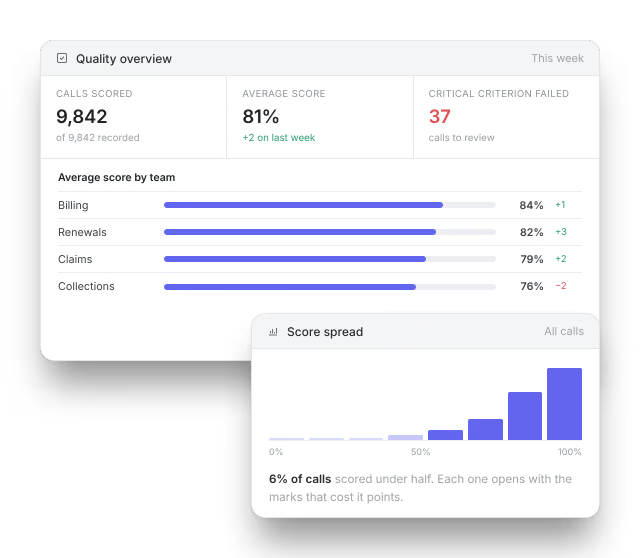
The Quality overview for one week: 9,842 of 9,842 calls scored, an average score of 81%, up two points, and 37 calls that failed a critical criterion. Average scores by team, from Billing at 84% to Collections at 76%, and the spread of scores across all calls, with 6% scoring under half
The Quality overview, shown with sample data.

What goes wrong

Quality that depends on luck

Sampling made sense when every review took a supervisor's afternoon. It still leaves most of your calls unheard, and the habits worth coaching are in the ones nobody heard.

  • A Sample Too Small to Coach

    A few calls per person each month can't tell a bad day from a habit, so feedback lands on whoever happened to be picked.

  • Feedback Days After the Call

    By the time a reviewed call reaches the person who took it, days have passed and they can't remember it, so the feedback doesn't stick.

  • A Scorecard Limited by Listening Time

    Scored by hand, a scorecard stays short, because every criterion costs a supervisor time. Scored with AI, review time stops being the limit, so the scorecard can cover what you never had time to check.


  • Compliance Found in a Complaint

    A skipped identity check or a missing recording notice turns up when a customer complains, months after the call.

What the platform does

A full review of every call

Quality scores each call against your scorecard soon after it ends, and turns the scores into coaching for each person and a clear view of what your customers need.

Every Call, Every Criterion

Recordings come straight from your contact-centre platform, or by upload, and every call is scored, or a share you set. Judgement calls get scored too: whether the tone held, whether the problem was solved. Each mark points to the moment in the call that earned it.

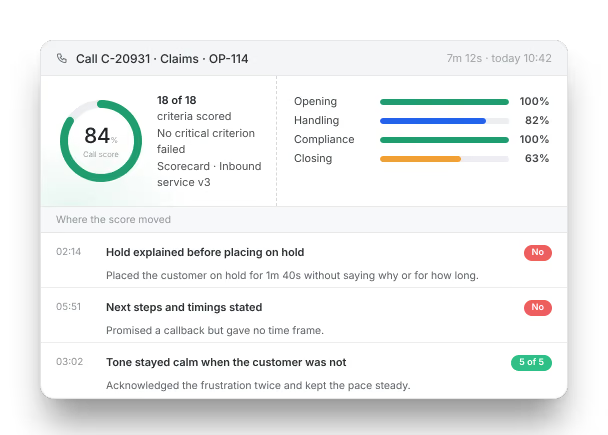
One scored call: advisor OP-114 on the claims team, 7 minutes 12 seconds, an overall score of 84% with each section of the scorecard scored, and the moments that cost points with the time in the call and the reason, such as a hold that was never explained
One scored call, shown with sample data.

Your Scorecard, Not a Generic One

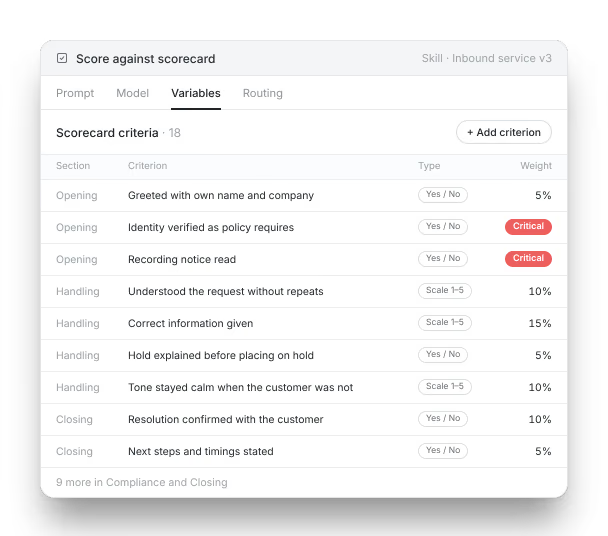
The scorecard is yours, and we help turn it into criteria the model applies the same way on every call. Some are yes-or-no checks, like reading the recording notice. Others are judgements on a scale, like whether the request was understood the first time. Add a criterion and it applies from the next call on.

The settings of the Score against scorecard skill, on its Variables tab: the client's scorecard as criteria, each with a section, a type such as yes or no or a scale of 1 to 5, and a weight, with two criteria marked critical. Nine of eighteen criteria are shown
The scoring step of a Quality workflow, shown with a sample scorecard.

Coaching From the Whole Picture

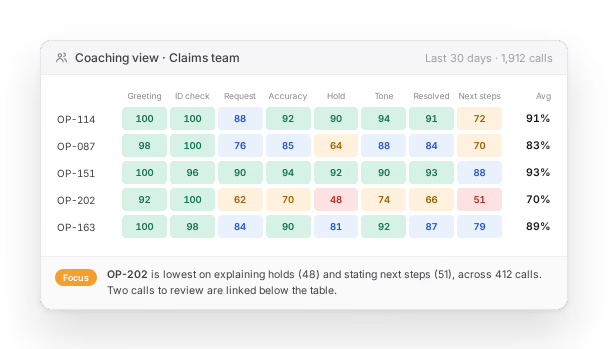
Scores add up by person and by criterion, across every call they took. A supervisor sees who struggles with what, backed by hundreds of calls instead of three, and opens the calls behind any number. The results also flow into the reporting tools you already use.

A coaching view for the claims team: five advisors against eight scorecard criteria over 30 days, each cell an average score. OP-202 is low on explaining holds, at 48, and on stating next steps, at 51, which are the two to coach first
A coaching view built from the scores, shown with sample data.

Why Customers Really Call

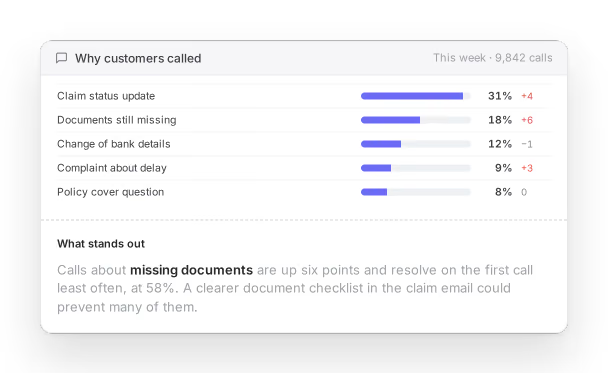
The same pass records why each customer called and what got in the way of an answer. You see the reasons rising this week and the ones that rarely resolve on the first call, which is where processes need fixing.

Why customers called this week, taken from the same scored calls: claim status updates at 31%, missing documents at 18% and rising, with a note that calls about missing documents resolve least often on the first call
Contact reasons taken from the same calls, shown with sample data.

Our clients

Companies that work with Visor

Beyond the scores

What the audits feed

Thousands of audited calls show how your contact centre really works: what customers ask and what your best people answer. Visor turns that into work you can act on. You don't need AI agents to use Quality, and if you build them, they start from all of it.

  • A Knowledge Base That Builds Itself

    The answers your best advisors give, call after call, become knowledge base articles, written from real calls instead of from scratch.

  • AI Agents Built From Your Calls

    When you build AI agents with Visor, they learn from thousands of audited calls: the questions your customers ask and the answers that resolved them.

  • Guardrails and Training, Suggested

    The audits show where a script needs a guardrail and which people need training on which criterion, with the calls to prove it.

  • Processes Worth Fixing

    Reasons that keep coming back without a first-call answer point to the process to change, with the volume behind each one.

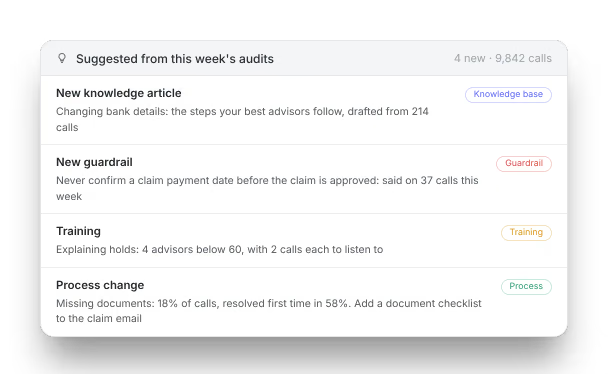
Suggestions drawn from this week's audits: a knowledge article drafted from 214 calls about changing bank details, a new guardrail against confirming payment dates early, training for four advisors on explaining holds, and a process change for calls about missing documents
Suggestions drawn from the audits, shown with sample data.

Questions buyers often ask

How can AI evaluate the quality of every call in our contact centre?
Quality & Insights AI Agent scores every call, or a share you set, against your own scorecard soon after the call ends. Recordings come straight from your contact-centre platform or by upload. Judgement calls are scored too, such as whether the tone held or the problem was solved, and each mark points to the moment in the call that earned it.
How can AI score advisors' calls and help coach them?
Quality scores each call against your scorecard, and the scores add up by person and by criterion across every call they took. A supervisor sees who struggles with what, backed by hundreds of calls instead of three, and opens the calls behind any number. The audits also show which people need training on which criterion, with the calls to prove it.

Choose what you allow. You can change it again at any time.

No choice saved yet. Cookie Policy