
Voice AI Agent
AI Agents That Answer Customer Calls
Building a voice agent is the easy part. The hard part is trusting it on a live line at peak hour, and that's the part this platform is built around.
Voice AI Agent
Building a voice agent is the easy part. The hard part is trusting it on a live line at peak hour, and that's the part this platform is built around.
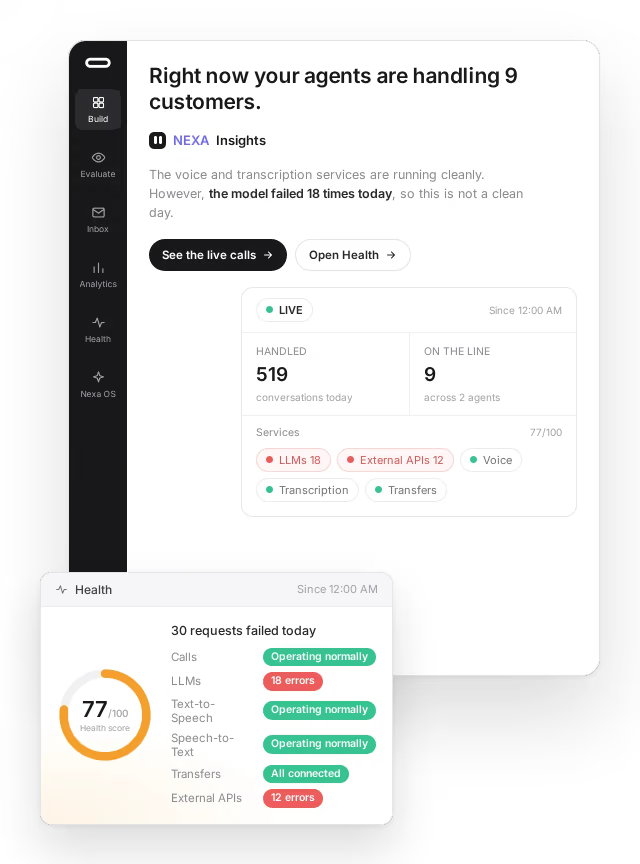
What goes wrong
A bad call costs more than a bad chat. Your customer can't scroll back or click a button, and they hear every pause.
The agent pauses long enough for your customer to start talking over it, and then it loses the thread.
The call reaches a person, who asks again for the policy number your customer already gave.
Nobody listens to every call, so you hear about the wrong answer when the complaint arrives.
A service the agent depends on changes after go-live. The agent gets worse without raising a single error.
What the platform does
Building is one of six areas on the platform. The other five exist so you can trust the agent once it's talking to your customers.
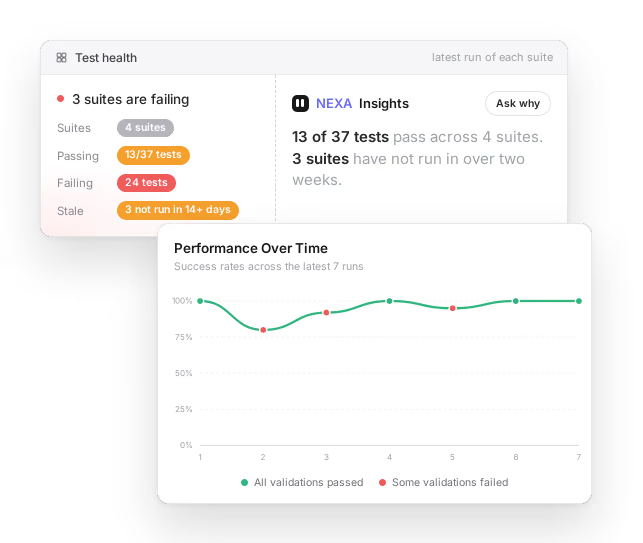
You write the scenarios your customers really bring, like the caller who changes their mind halfway or reads an account number out wrong. Each one runs against the agent repeatedly, with success criteria you set. Before any customer hears it, you have a consistency score per scenario and a ranked list of what fails most often.
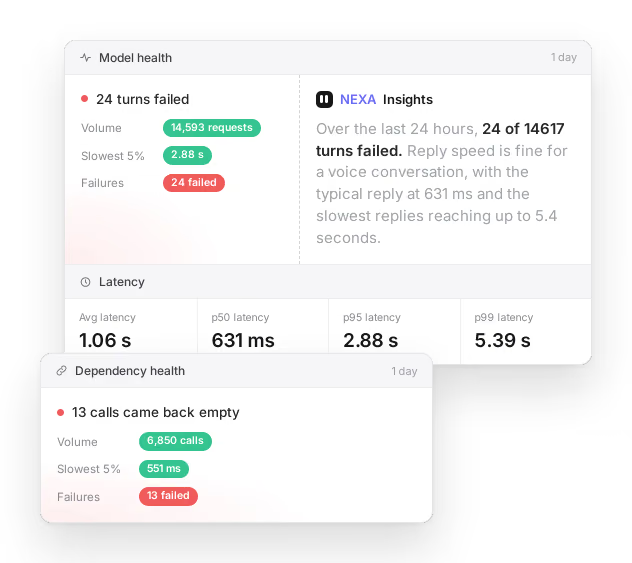
A voice agent depends on four or five services at once: the language model, speech recognition, speech synthesis and your own APIs. The platform measures each of them separately, so when a call drags you know which service caused it and at what latency percentile. Empty responses from your own systems are counted too.
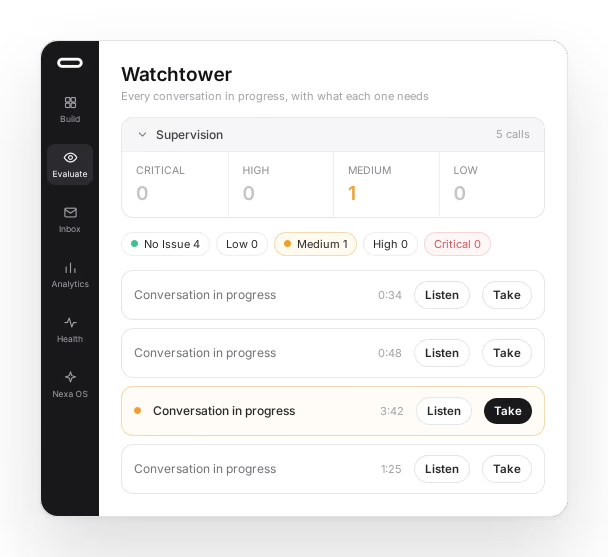
Watchtower shows every call in progress. A supervisor can listen in, and when a call needs a human, press Take. The transcript goes with it, so whoever picks up carries on from where Voice Agent stopped.
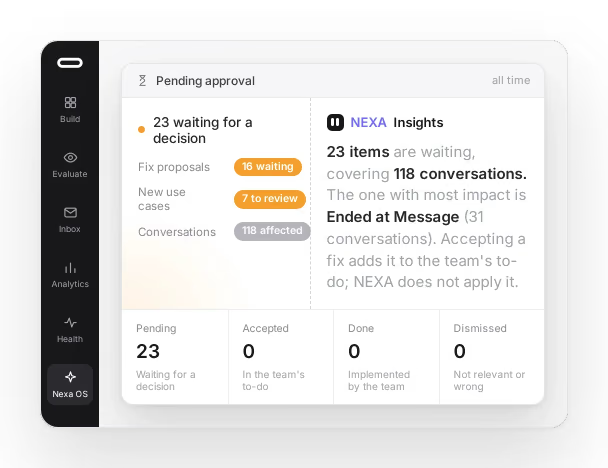
A deployed bot usually fails in silence. Nexa reads real conversations on a schedule and spots patterns no error log records, such as a run of calls ending at the same step. It writes down what it saw and proposes a fix, and nothing changes until someone on your team accepts it.
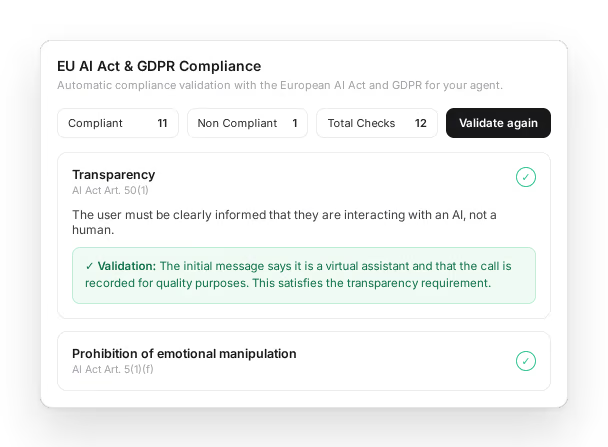
Each agent runs twelve automatic checks against the EU AI Act and the GDPR. Every check cites its article and quotes the evidence from the agent's own flow. When procurement asks how the agent complies, you answer from the product rather than from a document someone wrote once.
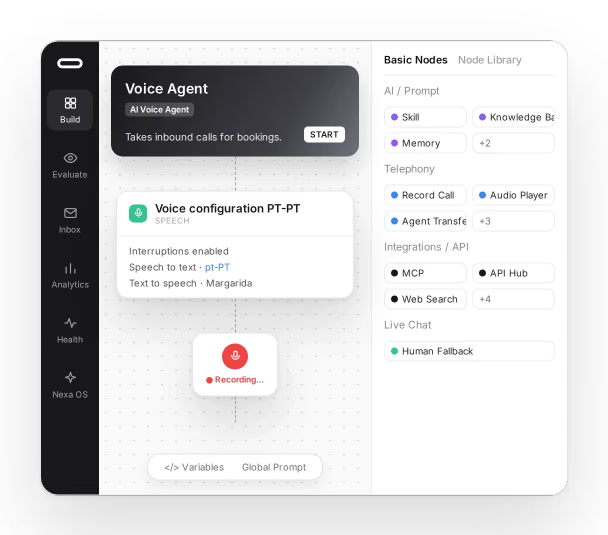
Each agent is a flow you can read on a canvas. The model behind each step and the speech services are settings on its nodes, so when a better model arrives the agent moves to it without a rebuild. A provider's price or policy change stays their problem rather than becoming yours.
The platform is compatible with models from Google, Anthropic, OpenAI and Microsoft. It connects to your telephony and to your contact-centre or CCaaS platform, so a call reaches the agent the way it reaches your people today.
Our clients































From kickoff to go-live, you work with named people who know your project, whether you come to us directly or through a partner.
We agree on what's in and what's out before we start, so everyone knows what success looks like.
Performance metrics are part of the build, so you see results from your first day in production.
We test end to end, then your team validates it in real conditions before launch.
We train your people to run the platform confidently, and we stay by your side for as long as you need us.
The models generate each answer in the moment and can occasionally fail. Visor's work is to contextualise them, apply controls and tune continuously. The solution runs on specialist providers who, like any provider, do not guarantee total availability. Judge the AI Agent by the standard you would apply to an experienced colleague: consistent and improving performance, not infallibility. The go-live is the start of the improvement, not the end of the project.